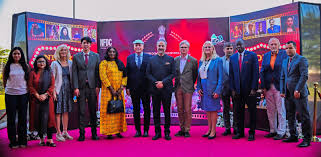













The High Commission of India in Abuja, in collaboration with the Kaduna International Film Festival, convened a special short-film screening and panel discussion on Tuesday evening to commemorate the advancing cultural and cinematic cooperation between India and Nigeria.

The event, which took place at the High Commission’s Chancery, was attended by members of the diplomatic corps—including several Heads of Mission—as well as professionals from the Nigerian film industry (Nollywood), cultural advocates, social influencers, and other associates of India.
According to a statement issued by the High Commission on Wednesday, the program was designed to serve as a platform for enhancing cooperation between the film sectors of both countries and for highlighting the increasing exchange of creative and artistic content through cinema.
In his remarks, the Indian High Commissioner to Nigeria, Ambassador Abhishek Singh, underscored the long-standing cultural affinities shared by both nations, particularly through the media and entertainment industries. He noted that Bollywood produces approximately 2,000 films annually across multiple genres and languages, and that Nigeria’s Nollywood ranks as the second-largest film industry globally in terms of output.
Ambassador Singh further referenced the presence of a significant Indian community in Nigeria, estimated at more than 50,000 persons, representing diverse regions of India. He recalled that, in partnership with Indian cultural associations, the High Commission organized film festivals in several Nigerian cities the preceding year.
The Ambassador also announced the introduction of a new cultural initiative titled “Bollywood and Yamarita,” which will feature screenings of Bollywood films accompanied by the serving of the traditional Nigerian dish Yamarita.
During the event, two short films—India’s Good Morning and Nigeria’s Not So Long a Letter—were screened, followed by a panel discussion themed “Celebration of Our Rich Cultural Heritage and the Need for Collaboration.”
The panel comprised journalist Swat Duniah-Adalumo (Moderator); filmmaker Dr. Ahmed Sarari; actor and filmmaker Francis Duru; and actress and filmmaker Stephnora Okere. According to the High Commission, the discussion examined the role of cinema in enhancing mutual understanding, promoting cross-cultural storytelling, and encouraging collaborative ventures between the Indian and Nigerian film industries.
Ambassador Singh also referenced recent advancements in bilateral cultural relations. He recalled that, during the State Visit of Prime Minister Narendra Modi to Nigeria in November 2024, both nations executed a Program of Cultural Cooperation and Exchanges for 2024–2029, intended to strengthen cultural ties and deepen people-to-people engagement. He further noted that a Memorandum of Understanding on film co-production is currently under review by both governments.
The envoy also acknowledged the contributions of Indo-Nigerian filmmakers such as Mrs. Hamisha Daryani, whose film Namaste Wahala premiered on Netflix in 2022, and whose six-episode series Postcards debuted in Lagos on 1 May 2024.
Regarding India’s upcoming cinematic programming, Ambassador Singh announced that the International Film Festival of India will be hosted in Goa from 22 to 28 November 2025, providing a unified platform for filmmakers, industry experts, and cinema enthusiasts worldwide. He noted that the festival’s International Cinema segment will feature an array of culturally and artistically significant films from across the globe.
India and Nigeria, which established diplomatic relations in 1960, have since maintained strong political, economic, and cultural ties. Bollywood films have historically enjoyed popularity in Nigeria—particularly in northern regions—since the 1970s. Nollywood, in turn, has emerged as one of the world’s most prolific film industries. Joint initiatives such as the 2021 Indo-Nigerian film Namaste Wahala and ongoing cultural program organized by the High Commission continue to enhance cooperation in the cinematic and cultural spheres.#newsafro_