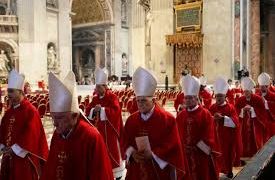








The final Mass before the conclave was a significant moment in the lead-up to the election of a new pope, with cardinals from five continents gathering in St. Peter’s Basilica in the Vatican to pray for guidance. The 133 cardinal electors who will participate in the conclave are tasked with choosing the successor to Pope Francis, who passed away last month after serving for 12 years.

With no clear frontrunner among the candidates, the election process is expected to be competitive. The cardinals represent a broad spectrum of the Church’s ideological traditions, from progressive to conservative, making the outcome uncertain. The new pope will need to navigate a series of complex challenges, including geopolitical tensions, ongoing issues within the Church such as infighting and the aftermath of the clerical child abuse scandal, as well as the broader issue of declining church attendance, particularly in the West.
As the cardinals prepare to enter the conclave and begin the voting process, the world will be watching closely to see how the Church’s future unfolds under the leadership of its next pope.
The pre-conclave Mass, presided over by Giovanni Battista Re, marked the final public ritual before the College of Cardinals secludes itself to elect the 267th pope. The Mass, which began at 10:00 am local time in St. Peter’s Basilica, was a solemn occasion for the cardinals as they prepared to enter the conclave, where they will vote in private for the next leader of the Roman Catholic Church.
After the conclave concludes and a pope is elected, the new pontiff will make his first public appearance on the balcony of St. Peter’s Basilica, likely within a few days. While previous papal elections have been swift — with both Pope Francis and his predecessor, Pope Benedict XVI, being chosen within two days — the history of papal elections includes some extraordinary delays. The longest papal election in Church history took place from 1268 to 1271, lasting an incredible 1,006 days.
As the cardinals prepare to enter the conclave, the anticipation grows, and the Church is once again poised for a significant turning point in its history.
The conclave for the election of the next pope is set to be one of the most significant and largest in Church history, with clerics from around 70 countries participating. To be elected, a candidate must secure at least 89 votes, a two-thirds majority among the 133 cardinal electors who are under the age of 80. These cardinals are staying at the Vatican’s Santa Marta guesthouse and Santa Marta Vecchia, awaiting the critical moment when they will gather to begin the process of selecting the next pope.
At 3:45 pm, they will begin their procession from Santa Marta to the Pauline Chapel of the Apostolic Palace for a prayer at 4:30 pm. Following this, they will enter the Sistine Chapel, a historic venue that Michelangelo famously adorned with his frescoes, where the conclave will take place. This event is shrouded in secrecy, as the cardinals take an oath to preserve the confidentiality of the voting process.
The senior elector, Cardinal Pietro Parolin, will open the proceedings by calling on God to grant the cardinals wisdom and peace as they carry out this sacred responsibility, selecting the leader of the world’s 1.4 billion Catholics.
As the conclave begins, Cardinal Pietro Parolin, a frontrunner and former secretary of state under Pope Francis, will lead the electors in the Latin chant “Veni, Creator Spiritus,” invoking the Holy Spirit to guide their decision-making. The cardinals have spent several days discussing the most pressing issues facing the Catholic Church, including the decline in priest numbers, the role of women, the Vatican’s financial struggles, and the need for the Church to adapt to the modern world.
With around 80 percent of the cardinals appointed by Pope Francis, the vote is seen as a potential crossroads for the Church’s direction. Some cardinals favor a leader who can continue and protect Francis’s progressive legacy, while others are seeking a more conservative defender of doctrine. There are many names being discussed, including Italian Pierbattista Pizzaballa, Hungary’s Peter Erdo, and Sri Lanka’s Malcolm Ranjith.
After the cardinals swear an oath of secrecy and agree to serve as pope if chosen, they will begin casting ballots. The votes are placed in an urn in front of Michelangelo’s Last Judgment, with only one ballot cast on the first night. If no decision is reached, the votes are burned with a chemical that produces black smoke; white smoke will signal the election of a new pope.
Outside, the faithful are gathered in St. Peter’s Square, eagerly watching the Sistine Chapel chimney for signs of the decision. The first vote results are expected by early evening, offering a glimpse of the conclave’s progress toward selecting the 267th pope.#newsafro_