















Renowned Nigerian author Babátúndé Lawal paints a haunting vision of Nigeria’s future in his latest book, Honeycomb. In this dystopian novel, Lawal delves into the political, social, and environmental challenges that loom on the horizon for Nigeria, exploring how corruption, climate change, and technological surveillance could converge to create a deeply unsettling reality. Through vivid storytelling and complex characters, he presents a society at a tipping point, where individuals must choose between self-preservation and collective resilience.

Honeycomb is described as both a cautionary tale and a call to action, urging readers to confront the trajectory of Nigeria’s current challenges. Lawal’s portrayal of Nigeria’s future is stark yet laced with hope, focusing on the potential for individual and community-based transformation even amidst overwhelming obstacles. The book has already sparked discussions for its gritty portrayal of themes like political exploitation, environmental degradation, and the societal impacts of emerging technologies on Nigeria’s youth.
Lawal, known for his incisive social commentary, uses Honeycomb to reflect real anxieties within contemporary Nigerian society, aiming to inspire dialogue around the pressing need for reform and sustainability.
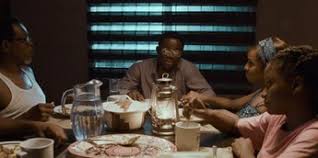
Honeycomb, co-produced by Babátúndé Lawal’s Arte House Studios and Meroestream, premiered at the Afropolis Festival, offering an intense, dystopian glimpse into Nigeria’s potential future in 2036. This film, scripted by Lawal and Tobi Marho, weaves together dark humor, grim irony, and razor-sharp social critique to create a narrative where survival hinges on power dynamics and moral decay. At its core are two disgraced politicians—once powerful, now hiding from an anti-government militia called the Anti-Government Coalition (AGC). Seeking refuge, they encounter “The Doctor” (played by Chukwu Martin), whose unsettling hospitality reveals both warmth and chilling undertones.
The Doctor’s family represents a moral reckoning, embodying a world stripped of conventional values where survival holds the only real currency. This is captured with sharp irony: when the politicians attempt to pay for a meal, the Doctor’s wife (Isoken Aruede) rebuffs them, delivering the line, “money has no value here anymore.” Her quiet intensity and nuanced indifference, alongside Martin’s magnetic yet cold portrayal, shape the claustrophobic and morally ambiguous world inside their home.
A standout moment arises when the Doctor’s daughter (Molayo Ogidan) unsettlingly addresses Emeka (Ben McAnthony) by name, exposing the family’s secrets and stirring dread that resonates with the film’s overarching themes. As Emeka transitions from arrogant politician to a victim of his own making, the story feels like a twisted form of justice, a punishment the men unknowingly set into motion.
The film’s visual style—crafted by Lawal alongside cinematographers Oluwayinka Akintunde and Damilola Abiodun-Olabiyi—draws viewers into an intimate and eerie world. Controlled, claustrophobic framing contrasts the emptiness of Nigeria’s desolate suburbs, amplifying the feeling of entrapment. Although the opening scenes may feel slow due to lingering shots of ruined streets, they succeed in establishing a foreboding atmosphere that immerses the viewer in Nigeria’s fractured landscape.
While the Doctor’s family could benefit from a more defined backstory, the film’s strength lies in its ambiguity, leaving audiences to grapple with the blurred lines of justice and survival. Honeycomb doesn’t just disturb; it challenges. As a reflection of contemporary Nigerian struggles with inequality and corruption, the film’s speculative narrative uses horror to critique society, offering a cautionary tale that’s both haunting and thought-provoking.