
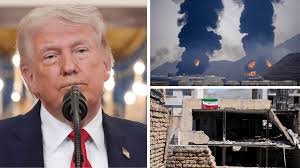










President Donald Trump and Israel launched strikes on Iran at a particularly sensitive moment for U.S.-Israeli relations. Just a day before the attacks, Gallup polls revealed Americans’ views of Israel had reached a 21st-century low, with many Americans sympathizing equally—or even more—with Palestinians than Israelis for the first time.

The political right in the U.S. has also become divided over how to address rising antisemitism among its base and influencers, with some prominent voices linking Israel conspiratorially to broader U.S. problems. In this environment, some Americans were quick to blame Israel for the conflict—and the Trump administration’s rhetoric has only fueled those perceptions.
Early in the escalation, Secretary of State Marco Rubio argued that Israel would strike Iran regardless of U.S. involvement, prompting retaliatory strikes against American targets. While intended to justify the war, this framing made it appear as though the U.S. was being pressured by Israel, a narrative the administration later abandoned.
Complicating matters, former National Counterterrorism Center Director Joe Kent recently resigned, citing Israeli pressure as a key factor in coercing the U.S. into war. Kent’s comments, including conspiracy-laden claims about Israel and other conflicts, drew widespread criticism—even though he held a powerful position under Trump despite past extremist associations.
Trump himself contributed to the confusion with a social media post claiming the U.S. was “aware of nothing” regarding Israeli strikes on the South Pars gas field in Iran—a move contradicted by U.S. and Israeli sources suggesting coordination. While this claim may have served Trump’s domestic political goals, it further fueled narratives suggesting Israel was acting independently or coercively, undermining the country’s reputation in the U.S.
Israeli Prime Minister Benjamin Netanyahu rejected the notion that Israel forced the U.S. into war, stating Israel “acted alone” and dismissing the idea of coercion as “ridiculous.” Yet the administration’s inconsistent messaging has raised questions domestically. At a Pentagon briefing and congressional hearings, officials struggled to clarify whether U.S. and Israeli objectives aligned, highlighting a lack of coherent communication.
The situation underscores a larger challenge: selling the war to the American public was always difficult, but the Trump administration’s shifting narratives and ad-hoc statements have complicated Israel’s public image further. As a result, American skepticism—and potential reputational damage for Israel—may linger long after the strikes themselves.#newsafro_