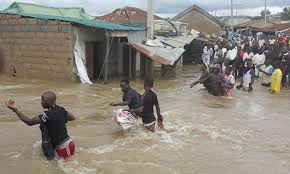

















For hundreds of families in Mokwa, Niger State, the observance of Eid-el-Kabir was marked not by celebration, but by profound sorrow and unresolved anguish. In place of customary festivities, many were left to contend with grief, unanswered questions, and the harrowing aftermath of a tragedy that has devastated their community.

While much of the world commemorated the Sallah holiday, residents of flood-affected areas continued the grim task of combing through debris, searching for missing relatives, and mourning those feared to have been lost to the catastrophic flooding of the previous week—an event that reportedly claimed nearly 200 lives and displaced over 3,000 individuals.
On Friday, fathers, mothers, and children alike reported having no cause for celebration, as they remained consumed by the search for missing family members.
According to a June 3 report published on the website of the National Emergency Management Agency (NEMA), the disaster resulted in 160 confirmed fatalities, 3,108 affected persons, 1,500 displaced, 84 still unaccounted for, and 11 injured.
In response, the Federal Government has approved a relief package of ₦2 billion earmarked for reconstruction efforts in the affected area, in addition to dispatching truckloads of food supplies to assist survivors. The Niger State Government has also pledged to support the displaced with food and other critical necessities.
Nevertheless, over a week since the disaster, many families have reported that their loved ones remain missing—an agonising reality that has cast a sombre pall over what would otherwise be a festive period.
Distressing Accounts from Displaced Victims
Displaced residents currently sheltering at Tasim Maza Primary School in Mokwa have recounted harrowing experiences that continue to overshadow any sense of festivity traditionally associated with the Eid-el-Kabir celebration.
One such victim, 23-year-old mother of two, Rukkayat Mohammed, shared her anguish over the disappearance of her husband in the aftermath of the catastrophic flood. Speaking with Saturday PUNCH, Mohammed explained that her family had made hopeful preparations for the Sallah holiday—plans that were cruelly derailed by the disaster.
“I don’t know how I feel,” she said, visibly distraught. “I have not seen my husband since this flood came. I am afraid he may have been carried away. Unfortunately, they have not recovered his body, so I don’t know whether he is alive or dead.”
When asked about her thoughts on Sallah, Mohammed’s response reflected the depth of her grief:
“How do you want me to celebrate Sallah when I am still searching for my husband?”
Her story is one of many echoing through the temporary camp—each narrative marked by loss, uncertainty, and an overwhelming sense of despair. The absence of loved ones and the trauma of sudden displacement have rendered this year’s celebration not one of joy, but of mourning.
In the wake of the catastrophic flood that struck Mokwa, Niger State, numerous victims have come forward with accounts that illustrate the profound human toll exacted by the disaster. These testimonies, given voluntarily to Saturday PUNCH, underscore not only the physical devastation wrought by the deluge but the ongoing emotional and psychological suffering of the displaced.
Eyewitness and Victim Testimonies
Rukkayat Mohammed, a 23-year-old mother of two, recounted that the last sighting of her husband occurred on the evening the flooding commenced. She stated:
“We were together that Wednesday night when the rain began. He went out to secure some of our belongings to prevent them from being swept away. That was the last time I saw him.”
Ms. Mohammed reported a total loss of property, expressing uncertainty regarding her husband’s status — alive or deceased — and described her condition as one of extreme emotional distress:
“Everything we had was carried away by the flood. Except for the clothes I am wearing, I have nothing left. I am in serious pain.”
Fatima Jibrin, another resident, lost two children in the flood, while her co-wife reportedly lost four. Ms. Jibrin described the day of the incident as “a black day” that would remain with her forever. She told Saturday PUNCH:
“This Sallah is not for me. I have lost everything. I don’t know what I am living for. The flood should have taken me also.”
She further elaborated that the disaster occurred at approximately 7:32 a.m., rapidly inundating their residence. According to her statement:
“Before we could get out, the water had already entered our houses. We didn’t see the children. We are hoping, at the very least, to recover their bodies.”
Sofiyat Liman, aged 25, reported the loss of four children — three girls and one boy — who were sleeping when the water struck. She said:
“I heard people shouting. I was confused and didn’t know what to do. Just like that, my children were gone. Even now, we haven’t found them. We’re still hoping to recover their bodies.”
Ibrahim Muktar, a long-time resident of Anguwan Hausawa, reported that he lost his entire family. He stated:
“We were sleeping when the water came. I’ve lived in Anguwan Hausawa for over 35 years. I have never seen anything like this.”
Relocation and Humanitarian Intervention
Displaced residents were initially directed to Kpege Primary School for shelter and support, pending official response from the Niger State Emergency Management Agency (NSEMA). However, upon assessment, many victims abandoned the site due to uninhabitable conditions and instead relocated to Tasin Maza Primary School.
At the latter site, Saturday PUNCH observed a significant concentration of displaced persons, predominantly women and children.
Representatives from the United Nations Children’s Fund (UNICEF) were present and had established a temporary field clinic. According to Theresa Pamma, UNICEF Water and Sanitation Specialist:
“We are responding to the flood situation by providing health services and addressing the risk of disease outbreaks. Temporary shelter, water source protection, and water treatment are part of our ongoing interventions.”
Ms. Pamma also acknowledged the presence of unaccompanied minors, noting that UNICEF is working to ensure these children remain in protective environments, stating:
“We are ensuring that displaced children—now staying with relatives or neighbours—are not subjected to abuse and are given the opportunity to realise their full potential.”
These accounts collectively depict a humanitarian emergency of considerable scale, characterized by widespread displacement, familial separation, property loss, and deep emotional trauma. The need for sustained governmental and international relief efforts remains critical as victims attempt to rebuild their lives and locate their missing loved ones.#newsafro_