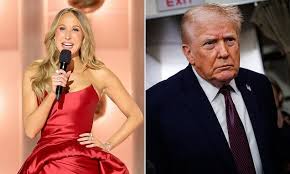











The 83rd Golden Globe Awards commenced on Sunday with opening remarks by host Nikki Glaser that included pointed references to President Donald Trump and his second administration, creating an initial impression that the ceremony would be overtly political in nature. Contrary to that expectation, the remainder of the event was largely devoid of explicit political commentary, with minimal references to the administration by presenters or award recipients.

Although Glaser did not mention President Trump by name during her opening monologue, she made indirect allusions to unreleased and redacted materials commonly referred to as the Epstein files, as well as to federal agencies and media organizations. In particular, she joked about document redactions and editorial practices, directing remarks toward the Department of Justice and the ceremony’s broadcast partner, CBS. She also referenced recent controversy surrounding CBS News leadership decisions, including criticism related to editorial judgment.
Following Glaser’s monologue, political commentary was notably limited. One exception was Amy Poehler’s acceptance speech, which included a brief, indirect remark concerning public broadcasting while humorously referencing NPR, a fellow nominee in the Best Podcast category.
A small number of attendees engaged in understated forms of protest. Mark Ruffalo, joined by Natasha Lyonne and Wanda Sykes, wore pins bearing phrases such as “Be Good” and “ICE Out,” which were reported to reference opposition to the activities of U.S. Immigration and Customs Enforcement under the current administration. The nature of the protest was not explicitly addressed on stage and may not have been apparent to television viewers.
Despite these isolated moments, the ceremony proceeded with its primary focus on entertainment and industry recognition. Glaser served as host for the second consecutive year, later describing the experience as a professional highlight and reaffirming her enthusiasm for returning to the role.
In terms of nominations and awards, One Battle After Another led the field with nine nominations, spanning major film categories including Best Picture, Director, Screenplay, and acting honors. The competition extended across both motion picture and television categories, with notable recognition for projects such as Adolescence, The White Lotus, Hamnet, and Sentimental Value. The event marked the first year podcasts were included among the award categories.
The ceremony ultimately underscored a contrast between its politically charged opening and its subsequent restraint, as the majority of participants elected to avoid overt political statements in favor of celebrating artistic achievement across film, television, and audio media.#newsafro_