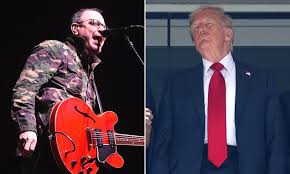








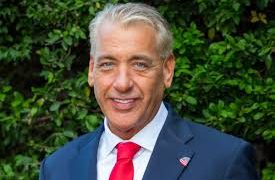



Canadian rock musician Mr. Matthew Good, aged 54, has encountered significant online criticism following his announcement to cancel a series of scheduled concert performances in the United States. The decision was framed as an act of protest against political policies associated with former U.S. President Donald J. Trump.

Mr. Good, a native of Burnaby, British Columbia, communicated the cancellation via a public statement posted on his official Facebook account on Friday. The affected tour locations included several U.S. cities, notably Buffalo, Cleveland, and Pittsburgh.
In his statement, Mr. Good addressed his American audience directly, writing:
“To my US fans, and friends… I’ve come to the personal decision, that I can’t, in good conscience carry out my dates this summer in your country.”
Mr. Good is known for a number of popular tracks, including “Decades” and “Hello Time Bomb.”
The announcement has generated substantial reaction on social media platforms, with critics mocking the gesture as ineffective, and some asserting that the artist’s absence would go largely unnoticed by the American public.
Mr. Matthew Good further elaborated on his decision to cancel his U.S. tour dates, stating:
“This is not fair to you, and I’m very well aware of that, but the truth is, every week that goes by, I have a deeper disdain for what’s going on there politically.”
Referencing former President Donald J. Trump’s trade policies, including tariffs, as well as other political actions undertaken during his second term in office, Mr. Good indicated that he would be unable to perform in the United States again unless significant political change occurs. He expressly acknowledged the potential professional consequences of his stance, stating that he was prepared to jeopardize his “future U.S. career to stand up against things today.”
Mr. Trump, in the six months following his return to office, has provoked criticism across Canada with a range of controversial statements and policies, including repeated references to Canada as the “51st state”—a remark widely perceived as dismissive of Canadian sovereignty and national identity.
In the wake of Mr. Matthew Good’s announcement cancelling his U.S. concert dates, numerous users on the social media platform X (formerly Twitter) issued critical responses, questioning both the rationale and impact of the decision.
One user asserted that the stated political reasoning was “likely an excuse due to lack of interest.” Another remarked sarcastically, “Those poor Americans. How will they ever get over this one?” accompanied by a broken heart emoji.
A further critic contended that Mr. Good was “only hurting himself and the people who work for the band financially,” further adding, “Americans won’t notice one way or the other.” Another post, referencing the scale of Mr. Good’s performances, stated: “One was a 400-seat brew pub. His date was sandwiched between trivia night and a cover band. He wasn’t doing a Las Vegas residency.”
In response to the backlash, Mr. Good expanded upon his reasoning via social media. He cited as a triggering event the recent decision by Canadian Prime Minister Mark Carney to withdraw a proposed digital services tax targeting U.S. companies—a measure that Mr. Good claimed had the potential to generate approximately $2 billion in revenue for Canada. According to Mr. Good, this decision was made to “appease” former President Donald J. Trump.
Mr. Good further cited logistical and political factors influencing his choice, including a “massive increase in visa costs” for touring artists, and concerns about ideological censorship. He expressed apprehension that, even with valid U.S. entry documentation, artists critical of the current GOP-led administration might face denial of entry. He stated:
“I end up in a situation where I’m biting my tongue, and losing what credibility I had to stand up and say something.”
He concluded that the prevailing political climate in the United States necessitated a clear, symbolic act to communicate his personal convictions and opposition to current policy trends.#newsafro_