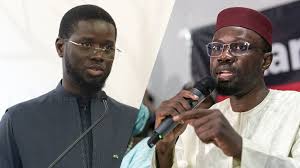













Senegal’s political landscape is facing growing uncertainty as tensions between President Bassirou Diomaye Faye and his former ally and mentor, Ousmane Sonko, continue to escalate.

The latest chapter in their widening feud unfolded after President Faye unveiled a new 30-member cabinet, less than two weeks after dismissing Sonko as prime minister and dissolving the previous government. The move signaled Faye’s determination to consolidate his authority and move forward with his agenda despite resistance from within his own political camp.
The dispute has sparked concerns about political stability in Senegal, particularly as the country grapples with mounting debt and economic challenges.
Although Sonko was removed from government, he remains a powerful political force. Shortly after his dismissal, lawmakers aligned with him elected him Speaker of the National Assembly. As the founder and leader of the ruling Pastef party, Sonko still commands significant influence over the party, which holds an overwhelming majority in parliament.
Despite his new position, Sonko has sought to strike a careful balance. While promising not to create institutional chaos, he has also made clear that parliament will not simply rubber-stamp government proposals.
Political analysts, however, believe President Faye retains the upper hand. Senegal’s political system grants substantial powers to the presidency, including control of the armed forces and the authority to dissolve parliament under certain circumstances.
According to observers, Faye appears increasingly determined to govern independently of Sonko’s influence. Several analysts argue that the president has surrounded himself with loyal allies who support his efforts to fully exercise the powers of his office.
Even though Sonko announced that Pastef would not participate in the new government, several individuals linked to the party were nevertheless appointed to cabinet positions. The development has fueled speculation about divisions within Pastef and whether Sonko’s grip on the party is beginning to weaken.
Some analysts suggest that the ruling party is experiencing internal fractures, with not all members willing to follow Sonko’s confrontational approach. Others believe the political showdown has strengthened Faye’s standing and reinforced his authority as head of state.
Sonko, however, remains defiant. Speaking to reporters, he questioned the political legitimacy of Faye’s new administration, arguing that it lacks a solid parliamentary foundation. At the same time, he stopped short of threatening the government, insisting that his supporters would cooperate while encouraging dialogue to prevent a deeper political crisis.
The political rivalry marks a dramatic turn in a relationship that once appeared unbreakable. After being barred from contesting the 2024 presidential election, Sonko personally selected Faye as his replacement, paving the way for his rise to the presidency.
But tensions began surfacing publicly in 2025, and the relationship has steadily deteriorated since then.
With local elections scheduled for 2027 and the next presidential election set for 2029, the struggle between Faye and Sonko is likely to shape Senegalese politics for years to come.
For now, both leaders appear determined to maintain their influence, setting the stage for a prolonged power struggle at the heart of Senegal’s government.#newsafro_