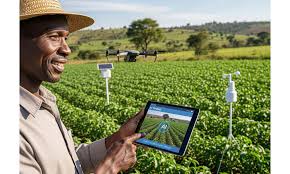


















In Kenya’s Kericho County, 33-year-old farmer Chepkorir Rotich begins her day long before sunrise. By the time most people are waking up, she has already milked her cows, sold the milk, fed her chickens, and harvested vegetables for customers who placed orders in advance.

For Rotich, farming is more than a livelihood—it is a passion. But it was not the career path she initially imagined.
After graduating from college over a decade ago, she hoped to secure a stable office job in business administration. Instead, months of unsuccessful job hunting pushed her into short-term contract work at various companies. Despite her qualifications, the highest-paying role earned her only about $200 per month, a salary she found difficult to survive on while living in Nairobi.
Faced with limited employment opportunities, Rotich decided to create her own path through agriculture.
Today, she combines farming with social media, using digital platforms to market her produce and educate others about modern farming techniques. Her online content has attracted nearly 50,000 followers, while her YouTube channel has become a resource for young people interested in agriculture.
Rotich believes the long-standing perception that farming is only for older generations discourages many young people from considering the sector.
She argues that the issue is less about age and more about access to land, which is often controlled by older individuals. Her own farming journey began in the small compound of a rented house. The venture became so successful that, after paying rent, her landlord often ended up owing her money for milk and vegetables he purchased from her.
Experts say young people could play a major role in transforming agriculture through technology. Kiringai Kamau, an agricultural economist at the University of Nairobi, believes youth are uniquely positioned to modernize farming because they are comfortable using digital tools and data-driven solutions.
To support this transition, educational institutions are creating programs that train young farmers to use artificial intelligence and agricultural data systems to improve productivity and decision-making.
Technology is already making a significant impact on farms across Kenya.
Just a few kilometres from Rotich’s farm, 32-year-old Geoffrey Kiprop is proving how digital skills can transform agricultural success. Although he earned a degree in information technology in 2017, he never secured permanent employment.
Like many graduates, Kiprop relied on temporary contracts maintaining computer systems for schools, earning modest wages. Today, however, he generates significantly more income through farming, making roughly 7,000 Kenyan shillings ($54) per day.
His farm combines dairy cattle, poultry, tea, coffee, beans, cabbage, and capsicum production. Drawing on his IT background, Kiprop uses a range of digital tools to maximize efficiency and profits.
Among his preferred technologies is the Plantix mobile application, which uses artificial intelligence to identify crop diseases and nutrient deficiencies from photographs. The platform also provides weather forecasts and farming recommendations tailored to local conditions.
Another tool, known as Virtual Agronomist, helps him map his farmland using GPS coordinates and generate nutrient management plans based on soil analysis.
For his dairy operation, Kiprop relies on the Digicow app, which tracks milk production, feed expenses, animal health records, and overall farm profitability.
Despite their successes, both farmers acknowledge that agriculture is not without challenges.
Rotich says many young people enter farming expecting quick returns and become discouraged when profits do not come immediately. She believes persistence is often the difference between failure and success.
“Consistency is key,” she says. “Many young people quit too early. You have to keep learning, keep trying, and learn from your mistakes before you can truly succeed.”
As unemployment continues to challenge many graduates across Kenya, young entrepreneurs like Rotich and Kiprop are demonstrating that agriculture, supported by technology and innovation, can offer a promising alternative for the next generation.#newsafro_