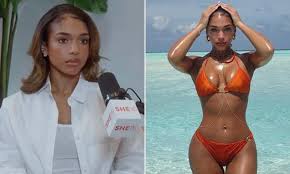

















Ms. Lori Harvey, aged twenty-eight, has publicly disclosed that she endured more than a decade of severe and unexplained symptoms before ultimately being diagnosed with polycystic ovary syndrome (PCOS) and endometriosis.

Speaking on an episode of SheMD with Dr. Thaïs Aliabadi and Ms. Mary Alice Haney, Ms. Harvey recounted years of frustration during which her medical concerns were repeatedly dismissed by healthcare providers. She explained: “I’ve been so frustrated. I’ve been going to my gynecologist because I’ve just been feeling like something’s off in my body. But every time I go to her, she’s like, ‘You’re fine, you’re fine, you’re fine. Nothing’s wrong.’ And I was like, ‘But I don’t feel fine. I feel like something is just off.’”
Ms. Harvey stated that it was only upon consultation with Dr. Aliabadi, a Los Angeles-based obstetrician-gynecologist noted for her high-profile clientele, that she finally received a definitive diagnosis and clarity regarding her longstanding health struggles.
Following Ms. Lori Harvey’s initial consultation, Dr. Thaïs Aliabadi determined that Ms. Harvey was suffering from multiple conditions, ultimately diagnosing her with both polycystic ovary syndrome (PCOS) and endometriosis.
According to Ms. Harvey, Dr. Aliabadi observed that her ovaries were “so swollen and inflamed” that conception at that stage would have been deemed “impossible.” Ms. Harvey recalled that her condition was so severe that within two days of the appointment, she underwent emergency surgery to remove what was later identified as a massive ovarian cyst.
Dr. Aliabadi explained that the cyst was an endometrioma—a growth on the ovary caused by endometriosis—which, if left untreated, could have destroyed Ms. Harvey’s fertility. The physician expressed confidence that, with appropriate treatment, Ms. Harvey possesses a strong ovarian reserve and would be able to conceive naturally in the future.
Ms. Harvey disclosed that she intends to undergo egg-freezing within the coming year as an “insurance policy” to safeguard her reproductive options.
The discussion also highlighted the challenges of diagnosing PCOS, which often goes undetected in up to 70 percent of cases. PCOS is a common hormonal condition affecting ovarian function, with hallmark features including irregular menstrual cycles, elevated androgen levels that may cause physical symptoms such as excess facial or body hair, and polycystic ovaries detectable via ultrasound. The condition affects approximately one in ten women of childbearing age in the United States and is a recognized factor contributing to infertility.#newsafro_