
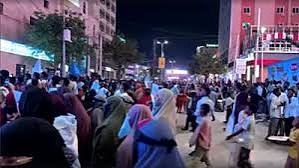
Hundreds of people took to the streets of Somalia’s capital, Mogadishu, on Thursday to express support for the government’s decision to expel the United Arab Emirates (UAE) ambassador.
The move follows accusations by President Hassan Sheikh Mohamud that the UAE has been supporting armed groups operating outside federal government control and undermining Somalia’s sovereignty.
The Somali government ordered the UAE ambassador to leave within 72 hours and recalled its diplomatic representative from Abu Dhabi. The dispute is partly linked to the UAE’s relations with three Somali territories: the breakaway region of Somaliland and the semi-autonomous regions of Puntland and Jubbaland.
Demonstrators voiced support for the president’s decision, with some accusing the UAE of acting against Somalia’s national interests.
“We support the decision, as the Emirates is an enemy, and Somalia is united against its enemy,” said protester Maryama Abdirahman.
The diplomatic tension follows Somalia’s decision in January to cancel agreements with the UAE covering ports, government institutions, security and defence cooperation. Authorities in Somaliland, Puntland and Jubbaland rejected the federal government’s authority to terminate agreements involving their territories.
Reacting to the latest development, UAE presidential diplomatic adviser Anwar Gargash criticized President Mohamud in a post on X, accusing him of prioritizing personal calculations over Somalia’s national interests.
The UAE has previously provided financial and military training support to Somali forces and invested in ports and other commercial projects. Abu Dhabi has consistently denied interfering in Somalia’s internal affairs.
Somalia Faces Wider Political Challenges
The diplomatic dispute comes as Somalia grapples with mounting political and security challenges.
The United Nations recently ended its political mission in the country after more than three decades of supporting negotiations between rival political leaders.
Efforts to establish a replacement mediation arrangement remain unresolved, while disagreements over elections have contributed to tensions and armed clashes in Mogadishu earlier this year.
The country’s political uncertainty has also intensified following a recent Supreme Court ruling that President Mohamud’s term had expired and ordering elections within 90 days.
The dispute with the UAE adds another layer of diplomatic pressure as Somalia continues to navigate questions of national sovereignty, federal authority and political stability.#newsafro_