
For the first time in Haiti’s history, three women have officially registered as presidential candidates, joining 30 men in the contest to lead the troubled Caribbean nation as it prepares for elections next year.
Among the female contenders is Dominique Dupuy, who briefly served as Haiti’s foreign affairs minister in 2024. She was previously nominated in 2020 to represent Haiti at UNESCO.
Dupuy has expressed confidence that Haitians are ready for a woman to become president, although she acknowledged that entrenched political interests could pose challenges to female leadership.
In a recent address shared online, she spoke about her travels across the country, describing the determination and resilience of its people. She pledged to help build the nation envisioned by Haiti’s ancestors.
The presidential race comes ahead of the country’s first general election in more than a decade. The list of contenders includes prominent political figures, former government officials, an economist, a prosecutor and the widow of assassinated former President Jovenel Moïse.
Haiti has been without an elected president since Moïse was assassinated at his private residence in July 2021 in an attack linked to an alleged coup plot. The country has since been governed by successive appointed prime ministers and a transitional presidential council, which was dissolved in February.
One of the candidates, Jean Ernest Muscadin, previously served as a public prosecutor under Moïse. The United Nations has accused him of killing dozens of people suspected of gang involvement or minor offences.
Former President Michel Martelly, who governed Haiti from 2011 to 2016, also registered his candidacy after returning to the country in October. He has faced allegations of facilitating drug trafficking and supporting armed gangs. Canada sanctioned him in November 2022, followed by the United States in August 2024.
Another contender is former interim Prime Minister and Foreign Affairs Minister Claude Joseph, who briefly led the government following Moïse’s assassination. He and Moïse’s widow were indicted in connection with the killing, but the indictment was subsequently dismissed. Both have denied wrongdoing.
Martine Moïse, the former first lady who was injured during the 2021 attack that killed her husband, also entered the presidential race in a last-minute announcement. She was previously investigated and indicted in Haiti over the assassination, but the charge was later annulled. She recently testified in a US federal court in proceedings involving suspects accused of participating in her husband’s killing.
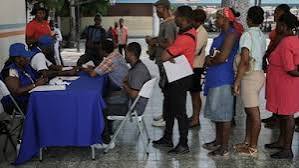
Meanwhile, voter registration is continuing across the country, with the government targeting between three million and six million registered voters to establish the legitimacy of the forthcoming elections.
Authorities are planning to hold the first round of voting on July 18 next year, followed by a second round on October 4. However, security concerns have raised questions about whether the country can organize credible elections within the proposed timetable.
Haiti continues to face widespread gang violence, with armed groups engaged in frequent clashes with the national police. Security operations are being supported by a UN-backed international Gang Suppression Force, alongside approximately 2,500 troops deployed by El Salvador.
Despite the fragile security situation, more than 100 political parties have registered, and campaigning is gradually gaining momentum.
The challenge for Haiti remains whether it can restore sufficient security and political stability to allow millions of citizens to participate in an election that could mark a significant step towards ending years of political uncertainty.#newsafro_