
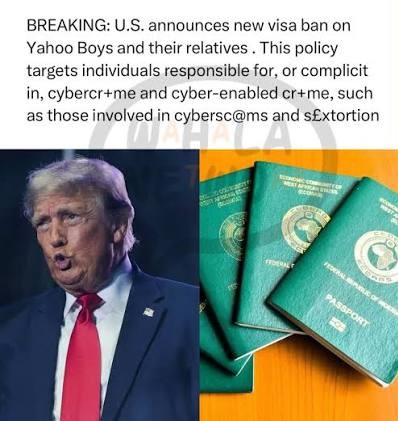
The United States has introduced a new global visa restriction policy aimed at foreign nationals involved in cybercrime, warning that even the immediate family members of suspected offenders could be barred from entering the country.
Announced by U.S. Secretary of State Marco Rubio, the policy is part of a broader effort by the Trump administration to combat transnational cybercrime networks responsible for billions of dollars in losses to American victims.
Under the new rules, individuals found to be responsible for or complicit in cyber-enabled crimes—including online investment fraud, romance scams, phishing attacks, financial fraud, and sextortion schemes—could face U.S. visa denials. The restrictions may also apply to their spouses and children as part of efforts to disrupt criminal organizations.
“By restricting visa issuance to those who are responsible for or complicit in these criminal enterprises, we are sending a clear message: The United States will go after those who prey on our citizens,” Rubio said in a statement.
Although the policy applies globally and does not single out any specific country, U.S. officials have previously identified cybercrime networks operating in regions including Nigeria, China, and parts of Southeast Asia as significant sources of online fraud targeting Americans.
The State Department said the move is backed by Section 212(a)(3)(C) of the U.S. Immigration and Nationality Act, which allows visa denials when an individual’s entry could have serious adverse foreign policy consequences. The measure also aligns with President Donald Trump’s Executive Order 14390, which directs federal agencies to intensify efforts against transnational criminal organizations.
According to U.S. officials, Americans lost an estimated $10 billion to online scams and fraud in 2024 alone. Authorities also say proceeds from cybercrime are often linked to money laundering, human trafficking, and public corruption, making the issue a broader international security concern.
Beyond visa restrictions, the U.S. government says it will continue pursuing sanctions, asset seizures, extraditions, and closer cooperation with international law enforcement agencies to dismantle cybercrime networks operating across multiple countries.
The State Department did not identify any individuals or organizations affected by the new policy, noting that visa decisions remain confidential under U.S. law.#newsafro_