
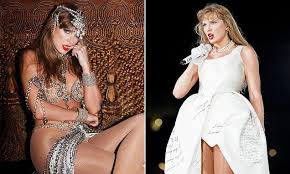
Following the October release of The Life of a Showgirl, Taylor Swift became the subject of online allegations asserting that certain themes in the album reflected “tradwife” ideology and political messaging associated with the MAGA movement. Subsequent analysis, however, indicates that a substantial portion of the critical commentary was amplified by automated or coordinated online activity.
The claims ranged from interpretations that specific lyrics promoted conservative social values to unfounded assertions that merchandise—including a lightning-bolt Opalite necklace—featured imagery associated with extremist groups. Some commentators questioned lyrics in the song Wi$h Li$t relating to domestic life and family, alleging they reflected racially coded themes. These interpretations circulated widely despite lacking factual substantiation.
Behavioral-intelligence company GUDEA performed an assessment of online activity between October 4 and October 18, reviewing more than 24,000 posts from over 18,000 users across multiple social-media platforms. According to GUDEA’s published findings, approximately 3.77 percent of accounts generated 28 percent of all Swift-related discussion during the review period, with the majority of those posts promoting conspiratorial narratives rather than commentary on the music itself.
Two significant surges in suspicious account activity were identified—on October 6–7 and again on October 13–14, the latter coinciding with the release of the lightning-bolt necklace. During the second surge, GUDEA reported that roughly 73.9 percent of Swift-related discourse originated from accounts exhibiting characteristics consistent with automated behavior or organized misinformation efforts.
The analysis concluded that many of the false claims began in fringe online communities and subsequently moved into broader social-media spaces. As the narratives spread, the conversation evolved, prompting comparisons between Swift and other public figures, including Kanye West—an example, GUDEA noted, of an initial false claim transitioning into wider, independent discussion.
The report also identified overlap between accounts involved in the Swift controversy and those active in an unrelated online dispute involving Blake Lively, with 2,395 accounts participating in both topics. GUDEA referenced this pattern as indicative of a “cross-event amplification network,” suggesting repeated involvement by the same users in multiple celebrity-related controversies.#newsafro_