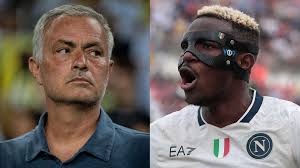










Victor Osimhen, the Nigerian football star, has found himself at the center of controversy after expressing support for his club, Napoli’s, anti-racist statement in response to comments made by José Mourinho, the head coach of Roma.

The dispute arose following a match between Roma and Napoli, during which Mourinho made comments that were interpreted by many as racist or discriminatory. In response, Napoli issued a strong statement condemning racism, and Osimhen, who has been a standout player for the club, publicly backed the club’s stance.
However, some people have criticized Osimhen’s support, accusing him of not properly understanding the situation or siding with the club for reasons other than principle. Others have voiced concerns that the statement may have been more about positioning in a larger political context than addressing the actual issue at hand.
This situation has drawn attention to the ongoing issue of racism in football, particularly in Italy, where incidents involving players and coaches have sparked public debates and led to calls for stronger anti-racist measures in the sport.
Osimhen’s support for the club’s position comes at a time when there are increasing discussions about racism in football and the responsibility of players, coaches, and clubs to take clear stances against discrimination.
Victor Osimhen has been at the center of a social media storm after expressing support for Galatasaray’s statement condemning Fenerbahçe manager José Mourinho’s comments following their recent 0-0 draw.
In the post-match interview, Mourinho made controversial remarks about the refereeing of the game, stating that he had gone to thank the foreign referee, Slovenian Slavko Vincic, for his performance. However, his comment about the Turkish referee, whom he described as a “disaster,” sparked anger and accusations of racism.
In response, Galatasaray issued a statement denouncing Mourinho’s remarks, calling them “anti-Turkish” and suggesting that they went beyond normal criticism. Osimhen, who had been involved in the match and is a key player for Galatasaray, backed the club’s stance, which led to a wave of backlash online.
Critics argued that Osimhen’s support for the statement was misguided and that he should have been more cautious in aligning himself with a statement that could be perceived as politically charged. Some also pointed out that while Mourinho’s comments may have been inappropriate, Osimhen’s vocal support for the statement seemed to be part of the growing social media polarization around issues of racism in football.
Mourinho’s remarks and Osimhen’s subsequent backing of his club’s response have reignited debates about how managers and players should navigate sensitive issues, especially in a climate where racism and discrimination continue to be major talking points in sports. The incident also highlighted the tensions that sometimes exist between clubs, managers, and players, particularly in a high-stakes, emotional environment like football.
Victor Osimhen’s support for Galatasaray’s anti-racism statement against José Mourinho has indeed caused a stir on social media. Following Mourinho’s controversial remarks, in which he allegedly made derogatory references to Turkish people, Galatasaray responded by condemning the comments as racist and announcing plans to pursue legal action against Mourinho. Osimhen, in turn, reposted the club’s statement in solidarity.
While Osimhen’s support for his club might seem natural to many, it has sparked criticism from some quarters. Critics argue that the situation could have been misinterpreted, with Mourinho’s comments possibly being taken out of context, especially given his history of outspoken, controversial remarks. Some believe that Osimhen’s involvement might not have been necessary and that he should have stayed out of the debate, avoiding being drawn into a complex, sensitive matter. One critic on X.com, for example, expressed frustration over Osimhen’s habit of posting quickly on social media, suggesting that the player should practice more patience in such situations.
Others feel Osimhen’s actions are simply a reflection of loyalty to the club paying him, seeing it as part of his role to support the team’s stance. Ultimately, the incident highlights how players, especially those with large social media followings, can find themselves caught between their professional responsibilities and the personal nuances of sensitive public debates.
The entire controversy underscores the challenges athletes face when navigating racially charged situations in the public eye, especially when their actions can be interpreted in multiple ways by fans, media, and other stakeholders.#newsafro_